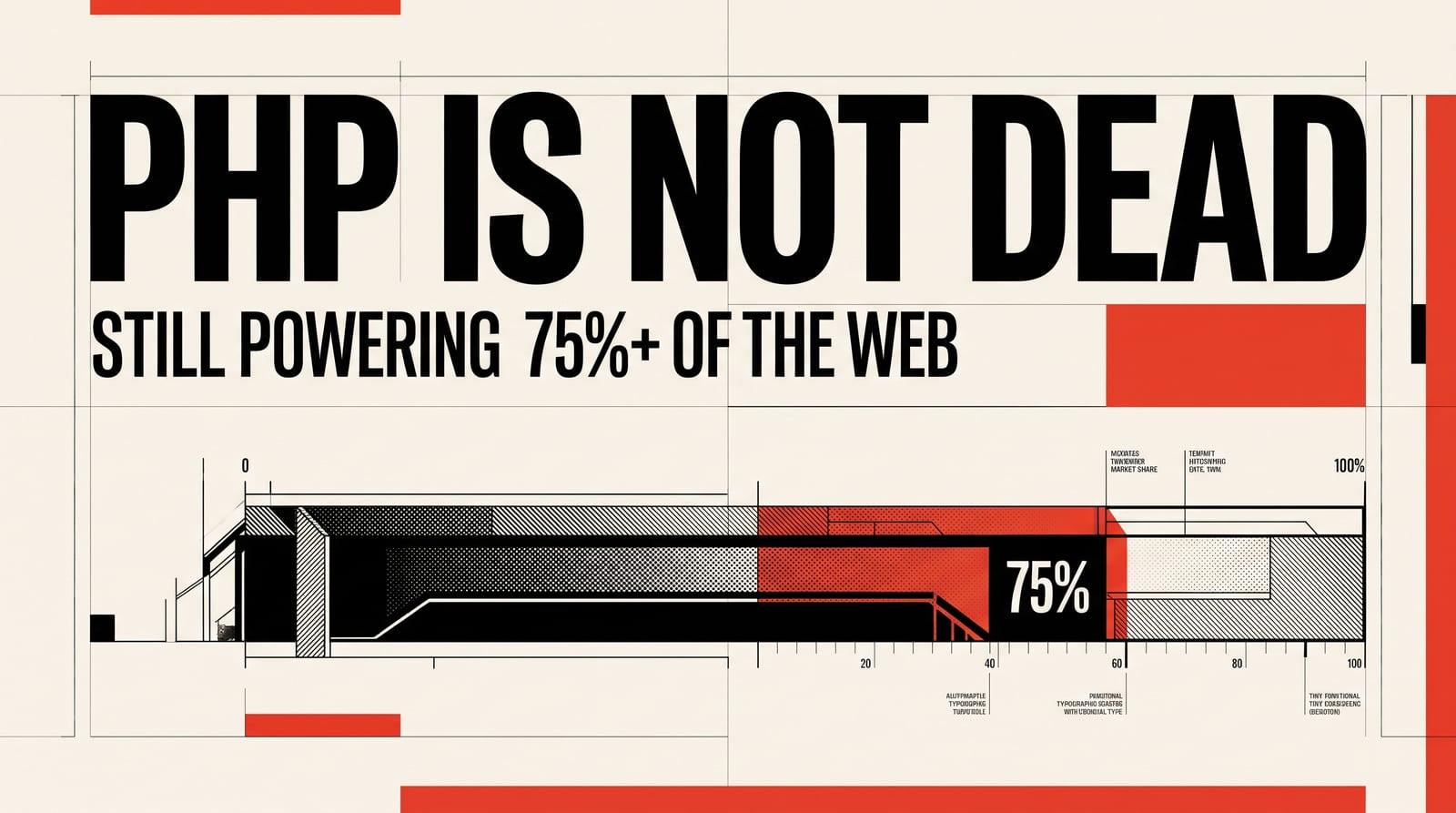
Over 75% of the web still runs on PHP, proving that rumors of its death are completely detached from reality. You probably hear tech influencers declare PHP obsolete every single week, making you second-guess your career choices and modern tech stack. Yet, when a critical PHP zero-day vulnerability recently struck the internet, millions of active production websites scrambled to patch their servers overnight. A dead language does not trigger global emergency updates across the majority of the web. Instead of falling for internet hype, look at the real infrastructure powering businesses today and discover why modern PHP and Laravel remain indispensable.
What the numbers say
According to W3Techs, PHP is still the server-side language behind roughly three quarters of all websites whose language is known. No other server-side language comes close. That share includes WordPress, Drupal, Joomla, MediaWiki, and countless custom business applications, many of them quietly earning money every day.
Popularity on social media and market share in production are two different things. Hype measures what people talk about. Infrastructure measures what businesses actually depend on.
What the CVE-2024-4577 incident showed
In June 2024, researchers at DEVCORE disclosed CVE-2024-4577, a remote code execution flaw caused by CGI argument injection in PHP running on Windows. It is tracked in the NIST National Vulnerability Database, and PHP released fixed versions the same month.
The reaction is the interesting part. Scanning data from the Shadowserver Foundation documented a very large number of public IP addresses that were exposed, and administrators rushed to upgrade PHP. Emergency patching at that scale only happens when a technology is deeply embedded in real production systems.
The incident also carries a practical lesson. The most exposed setups were Windows servers running PHP through CGI, a configuration common in XAMPP-style installs. If you are still running a local stack in production, read our article on why you should use IIS instead.
Modern PHP is not the PHP you remember
Much of the criticism targets PHP 5 habits from fifteen years ago. The language has changed a lot since then.
- A real type system. Typed properties, union types, return types, and strict types catch bugs before they reach production.
- Modern syntax. Enums, readonly properties,
matchexpressions, attributes, named arguments, and constructor promotion make code shorter and clearer. - Much better performance. PHP 7 and 8 are many times faster than PHP 5, and OPcache with JIT is available for heavier workloads.
- Mature tooling. Composer, PHPStan, Psalm, PHPUnit, and Pest give PHP the same quality workflow you expect from any serious language.
Why Laravel remains indispensable
Laravel turned PHP into a productive, well-organized framework, and that is a large part of why the language stays relevant.
- Batteries included. Authentication, authorization, validation, queues, scheduling, mail, caching, and file storage ship with the framework.
- Eloquent ORM and migrations. Database work stays readable and versioned.
- A deep ecosystem. Sanctum, Horizon, Octane, Livewire, and Inertia cover APIs, background jobs, high-performance serving, and modern front ends without leaving the framework.
- Fast to ship. A small team can deliver a complete product, such as a POS, an ERP, or a member portal, in the time other stacks need to finish their setup.
- Easy to host and to hire for. PHP runs on almost any server, from shared hosting to containers, and the talent pool is large.
Choosing a stack without the hype
No language is right for everything. Instead of following the loudest opinion, ask four questions:
- What problem does the product solve, and how fast must it ship?
- Can your team build and maintain it well in this stack?
- Is there a mature ecosystem for authentication, payments, reporting, and deployment?
- How easy is it to find developers and hosting for the next five years?
For business applications, content platforms, and e-commerce, PHP with Laravel answers all four well.
Keep your PHP patched
A healthy language still needs a healthy server. Track the PHP version you run, subscribe to security advisories, upgrade to supported releases, and never leave an end-of-life version in production. Treat patching as routine maintenance, not an emergency.
Conclusion
PHP is not dead. It is quiet, mature, and everywhere. The fact that the world reacted so quickly to a single vulnerability is proof of how much of the web depends on it. Modern PHP and Laravel give you a fast, secure, and maintainable foundation, as long as you keep them up to date.
References
- PHP usage statistics (75%+ of websites): W3Techs: Usage statistics of PHP for websites. Shows PHP holding roughly 75% to 77% of all websites whose server-side language is known.
- PHP vulnerability incident (CVE-2024-4577): NIST NVD: CVE-2024-4577 and DEVCORE security advisory. A remote code execution flaw via CGI argument injection in PHP on Windows that forced emergency patching across many servers.
- Global scan data after the incident: The Shadowserver Foundation: CVE-2024-4577 dashboard. Documents the public IP instances detected as vulnerable and the rush to update PHP versions.